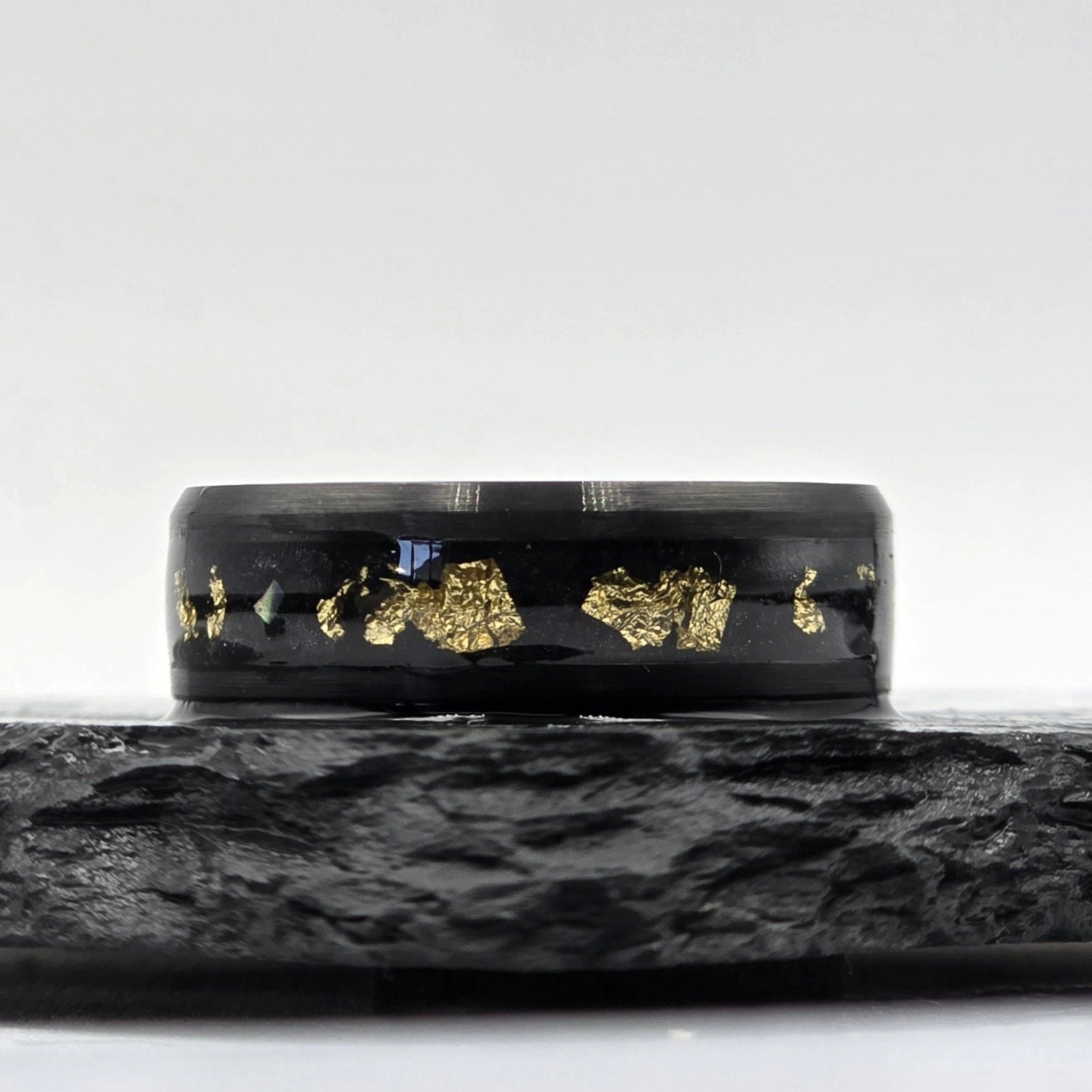

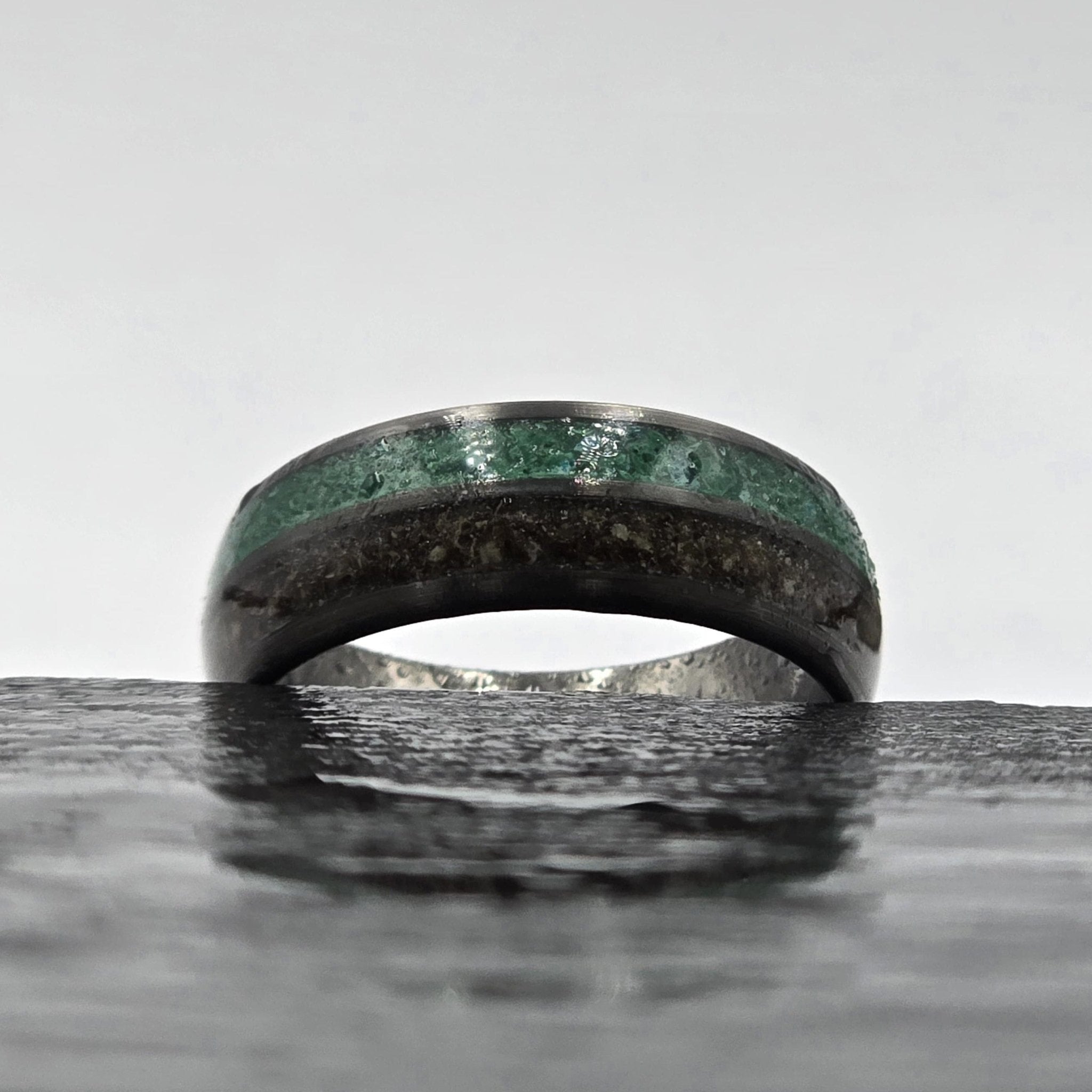
The Rebirth Ring – Agatized Dinosaur Bone and Malachite in Gunmetal Tungsten
Introduction
Some objects blur the line between artifact and art. The Rebirth Ring is one of them. At first glance, it’s a striking piece of modern jewelry: brushed gunmetal tungsten, bold inlays, and a confident, masculine silhouette. Look closer, and you realize you’re wearing something far rarer—a fragment of Earth’s deep past, preserved for roughly 160 million years and transformed into a functional, everyday ring.
This is not jewelry inspired by history. It is history. The ring features agatized dinosaur bone sourced from the Jurassic-era deposits near Bouarfa, paired with vivid green malachite and set into a rugged tungsten band engineered for durability. Each element tells a different part of the story: prehistoric life, geological transformation, and modern craftsmanship coming together in one uncompromising design.
In a world of mass-produced accessories, the Rebirth Ring stands apart as a piece of wearable provenance. It appeals to collectors, designers, and anyone drawn to materials that carry meaning beyond surface beauty. This article explores the science behind agatized dinosaur bone, the symbolism of malachite, the engineering advantages of tungsten, and the meticulous craftsmanship that binds these materials together. Along the way, you’ll learn how to wear, care for, and truly understand a ring that is as much a statement of identity as it is a feat of design. See more men's rings here.
What Is Agatized Dinosaur Bone?
Agatized dinosaur bone is not simply fossil bone preserved in its original state. It is a geological transformation—one that requires rare conditions, immense time, and precise mineral chemistry. When a dinosaur bone is buried under sediment, groundwater rich in silica can slowly infiltrate the porous structure of the bone. Over millions of years, the original organic material is replaced molecule by molecule with silica, the same mineral family that forms agate and quartz.
The result is extraordinary. The bone’s microscopic cellular structure remains intact, but it is now stone—hard, polishable, and capable of displaying vivid colors. These colors come from trace minerals introduced during the fossilization process, such as iron, manganese, or copper. This is why agatized dinosaur bone can appear red, orange, blue, or earthy brown, often with intricate, honeycomb-like patterns.
From a jewelry perspective, this material is prized because:
-
It is genuinely ancient, often dating back more than 150 million years.
-
Each piece is visually unique due to natural mineral variation.
-
It combines scientific rarity with aesthetic impact.
Importantly, agatized dinosaur bone is legally collected from surface deposits in regions where fossil recovery is permitted. When used responsibly, it allows fragments of natural history to be preserved and appreciated in a new form, rather than eroding away unseen in the desert.
Origins of the Dino Bone in The Rebirth Ring
The agatized dinosaur bone featured in the Rebirth Ring originates from Jurassic deposits near Bouarfa in eastern Morocco. This region is known among geologists and paleontology collectors for its rich fossil beds, which date back approximately 160 million years to the late Jurassic period.
The dinosaurs that once roamed this region were likely sauropods—massive, long-necked herbivores that dominated the landscape. When these animals died, some of their bones were rapidly buried by sediment, protecting them from decay and scavengers. Over time, silica-rich groundwater flowed through the surrounding rock, initiating the slow process of permineralization.
What makes Moroccan agatized dinosaur bone particularly valued is the clarity of its preserved structure. Under magnification, you can still see the original bone’s cellular patterns, now locked in stone. These patterns are not decorative additions; they are the fossilized imprint of living tissue from a creature that walked the Earth before continents took their modern shape.
Wearing this material is not about novelty. It is about connection—to deep time, to Earth’s geological processes, and to a moment in natural history that predates humanity by an almost unimaginable margin. In the Rebirth Ring, that connection is front and center, not hidden or diluted.
Malachite — The Green Gem of Transformation
Malachite has captivated human civilizations for thousands of years, long before it ever met dinosaur bone in modern jewelry. This copper carbonate mineral is instantly recognizable by its vibrant green color and distinctive banding, which forms as copper-rich solutions crystallize over time.
Historically, malachite has been used as:
-
A pigment in ancient paints and cosmetics.
-
A decorative stone in architecture and sculpture.
-
A symbolic material associated with protection and transformation.
The symbolism is particularly relevant in the Rebirth Ring. Malachite is often linked to growth, renewal, and change—concepts that resonate deeply when paired with fossilized bone. One material represents deep, ancient time; the other represents continuous transformation driven by Earth’s chemistry.
Visually, malachite provides a powerful contrast. Its rich green tones cut through the earthy, complex patterns of agatized dinosaur bone, creating a dynamic inlay that draws the eye without overwhelming the design. This balance is intentional. The malachite does not compete with the fossil; it frames it, emphasizing both materials through contrast.
Because malachite is softer than many gemstones, its inclusion in a ring requires careful engineering—something addressed through sealing and protective finishing, which we’ll explore later.
Why Tungsten? The Metal Behind the Ring
Tungsten carbide has become a cornerstone material in modern jewelry, and for good reason. Originally developed for industrial applications, tungsten carbide is renowned for its extreme hardness and resistance to wear. On the Mohs hardness scale, it ranks far above traditional precious metals like gold or silver.
For the Rebirth Ring, tungsten offers several critical advantages:
-
Exceptional scratch resistance, making it ideal for daily wear.
-
Structural stability, ensuring the inlays remain secure.
-
A substantial weight that conveys durability and presence.
The gunmetal finish adds another layer of appeal. Unlike high-polish metals that show wear quickly, brushed gunmetal tungsten develops character over time while maintaining its core integrity. It complements the organic materials in the inlay, grounding them in a modern, industrial aesthetic.
From a practical standpoint, tungsten also requires minimal maintenance. It does not tarnish, does not bend under normal use, and retains its shape even under pressure. For a ring designed to carry million-year-old materials, this stability is essential.
Craftsmanship and Design — From Fossil to Finished Ring
Transforming raw fossil and gemstone into a wearable ring requires more than cutting and setting. It demands a process that respects the integrity of ancient materials while meeting modern standards of durability and comfort.
The creation process typically involves:
-
Precision cutting of agatized dinosaur bone and malachite into uniform inlay segments.
-
Careful fitting of these segments into a machined tungsten channel.
-
Sealing the inlays with waterproof epoxy to protect against moisture and impact.
-
Finishing the band with a brushed gunmetal texture and comfort-fit dome interior.
The epoxy sealing is particularly important. It stabilizes the malachite and fossil, preventing chipping and preserving the surface finish over time. This allows materials that would normally be too delicate for daily wear to function reliably in a ring.
Attention to ergonomics is equally important. The comfort-fit dome shape ensures the ring sits naturally on the finger, reducing pressure points and making it suitable for extended wear. This is where craftsmanship elevates the piece from a novelty to a functional heirloom.
The Visual Story — Aesthetic Appeal & Unique Patterns
No two Rebirth Rings are identical. That is not a design limitation; it is the defining feature. Agatized dinosaur bone displays natural cellular patterns formed by the original bone structure, while malachite contributes flowing green bands that are never repeated in exactly the same way.
Together, these elements create a visual narrative:
-
Fossil patterns evoke structure, age, and resilience.
-
Malachite bands suggest movement, growth, and energy.
-
Gunmetal tungsten frames both with modern restraint.
For wearers, this means the ring becomes a personal signature. It is immediately recognizable, yet impossible to duplicate. In an era where individuality is increasingly valued, this uniqueness is a powerful form of expression.
Symbolism and Personal Meaning
Jewelry has always carried symbolic weight, and the Rebirth Ring leans into that tradition without becoming abstract or pretentious. The materials themselves do the talking.
Agatized dinosaur bone symbolizes endurance, legacy, and the passage of time. It is a reminder that existence extends far beyond human timelines. Malachite, by contrast, represents transformation and renewal—change driven by natural forces.
Together, they form a narrative of continuity. The past is not erased; it is transformed and carried forward. For many wearers, this resonates on a personal level, marking milestones, transitions, or commitments with something that feels grounded and meaningful.
Durability & Practical Wear — Built for a Lifetime
Despite its ancient components, the Rebirth Ring is designed for modern life. Tungsten’s hardness protects the structure, while epoxy-sealed inlays guard against moisture and daily wear.
Practical care tips include:
-
Cleaning the ring with mild soap and water.
-
Avoiding prolonged exposure to harsh chemicals.
-
Storing it separately to prevent contact with abrasive surfaces.
These simple habits help preserve the finish and ensure the inlays remain vibrant. With proper care, the ring is built not just to last a lifetime, but to remain visually compelling throughout it.
Comparisons — How It Stands Against Other Rings
Compared to traditional gold or platinum bands, the Rebirth Ring offers a fundamentally different value proposition. Precious metals emphasize rarity through scarcity and market value. This ring emphasizes rarity through time, geology, and natural history.
Unlike purely decorative gemstone rings, it tells a story that cannot be replicated synthetically. And unlike trend-driven designs, its appeal is rooted in materials that predate fashion entirely. That makes it particularly compelling for those who want jewelry with depth, not just shine.
Collector’s & Gifter’s Guide — Who Should Wear This Ring?
The Rebirth Ring appeals to a wide audience, but it resonates most strongly with:
-
Individuals who value unique, story-driven design.
-
Collectors of natural history or geological specimens.
-
Gift-givers seeking something symbolic and unforgettable.
As a gift, it works best when presented with its story. Explaining the age, origin, and transformation of the materials adds emotional weight that no generic accessory can match. It is less about adornment and more about meaning.
Conclusion
The Rebirth Ring is more than a ring. It is a convergence of deep time, geological transformation, and modern engineering. By combining agatized dinosaur bone from the Jurassic era with malachite and gunmetal tungsten, it transforms ancient remnants into a durable, wearable artifact.
In doing so, it challenges conventional ideas of luxury and value. Instead of relying on tradition alone, it draws power from authenticity, rarity, and narrative. For those who wear it, the ring becomes a quiet declaration: style can have substance, and history can be carried forward, not locked away.
This is not just a fossil you can flex. It is a reminder that even after 160 million years, transformation never stops.